The long-time worry about the safety of minority people in Bangladesh is back again because of recent events in Chittagong. In just five days, four minority family houses were purposely set on fire. This is not just a small crime, it is a sign of growing violence against minorities and a threat to their lives. We need to look at these events seriously because they look like planned terror.
Details of the Events: A Scary Chain
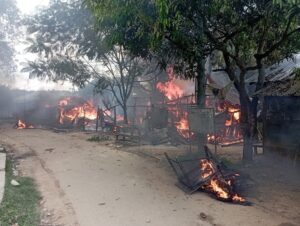
The latest event happened in Chittagong’s Raozan Upazila on December 23, around 3:30 AM. In West Sultanpur village, a planned attack hit the families of Sukh Shil, who works in Dubai, and Anil Shil, a daily laborer. Eight family members were sleeping peacefully when they suddenly saw their house burning. When they tried to run out, they found the doors were locked from the outside. This proves it was a plan to kill them. They only survived by cutting through tin and bamboo walls and escaping with great courage. But their passports, about 100,000 taka in cash, and all house things turned to ash in the fire.
This is not the only case. Just three days before, on the night of December 19, in Dheuyapara village, two other minority families had their doors locked from outside and set on fire in the same way. The day before that, on December 18, a man named Sadhan Barua’s house in Keutia Barua Para village was also burnt.
There is a common pattern in these events—every time, Hindu families were the targets, and every time, the doors were locked from outside so people could not run away. This shows the goal was not just to destroy property, but to kill people.
Bigger Context of Minority Attacks In Bangladesh
Attacks on Hindus and other religious minorities in Bangladesh are not new. Since the country’s independence, there have been communal attacks, land grabbing, torture of women, and attacks on religious places. But in recent years, these attacks seem more organized and planned.
In 2021, during Durga Puja, there were big attacks on Hindus in Comilla and other places. People still remember that. Even though the government promised many things after that, no real steps were seen to keep minorities safe. These recent events in Chittagong prove that minorities are still not safe in their own homes and their own country.
These crimes are not just personal attacks. They are a plan to make a community live in fear, break them financially, and torture them mentally. When a family loses all their savings, important papers, and ways to earn money, they don’t just lose property—they lose their dignity and dreams for the future.
State Duty and Rule of Law
After this event, the Raozan Police Officer-in-Charge said seven people were arrested and the investigation is going on. The Upazila Nirbahi Officer promised to help the families. These steps are good, but the question is—what happens after the arrest? Will the criminals really get punished, or will this be covered up like before?
A big problem in Bangladesh is the “culture of no punishment” for crimes against minorities. Many times, after some noise and a few arrests, the cases do not move. Because of local powerful people, criminals often get free or get very small punishments. This gives them courage to do the same crime again and again.
The first duty of the state is to protect the life and property of all citizens. The constitution says all citizens are equal regardless of religion. But when one specific community is targeted again and again, it is clear that these rights are only on paper.
Social and Mental Impact
The impact of such attacks is not just on the victim families; it creates deep fear in the whole minority community. When a family is attacked while sleeping in their own home, everyone feels unsafe. People don’t feel safe in their houses and are scared to sleep at night.
Sukh Shil is an expat who worked hard abroad for his family’s future. Anil Shil is a simple laborer working hard every day. But in one night, all their dreams were destroyed. They didn’t just lose property, they lost their dignity, their sense of safety, and their faith in the right to live in their own country.
These events force minority people to leave the country. In the last few decades, many Hindus and other minorities have moved to India or other countries. The main reason for this is lack of safety and discrimination. It is very sad for a country when its citizens are forced to leave just because of their religion.
International Human Rights and Bangladesh’s Position
The UN Declaration of Human Rights (UDHR) says everyone has the right to life, liberty, and safety. Article 18 talks about freedom of religion. As a signer of this, Bangladesh must protect these rights.
Also, international agreements like ICCPR and ICESCR clearly say the state must protect all citizens regardless of religion or race. Bangladesh is part of these too.
But the reality is, these international promises are not happening on the ground. International groups like Human Rights Watch and Amnesty International have often expressed worry about minority torture in Bangladesh and asked the government to take real action.
The Way Forward: Suggestions and Demands
These events in Chittagong make us feel ashamed as a nation. In a civilized society, no human should fear being burnt to death while sleeping at home. To change this, we need to take some urgent steps:
Immediate and Fair Investigation: There must be an independent investigation of these four events and other related cases. Criminals must be identified and punished quickly.
Effective Laws for Minority Protection: Bangladesh has laws, but they are not used well. We must make sure laws are followed correctly.
Rehabilitation of Victims: Families should not just get promises, they need real help to rebuild and get compensation. They also need mental health support and safety.
Increasing Awareness: We need to teach tolerance and respect for everyone in schools and society to keep peace.
Accountability of Local Administration: If local officials fail to protect minorities, they should be held responsible.
Conclusion
These events in Chittagong are not just a few small crimes. They are a scary sign of growing violence against minorities in Bangladesh. As long as we don’t take this problem seriously, minorities will feel like foreigners in their own country.
To build a truly democratic and non-communal Bangladesh, we must ensure every citizen is safe and live with dignity. It is our duty as a nation to make sure people like Sukh Shil and Anil Shil can sleep safely in their homes.
This writing is not just a report, it is a call for justice, a call for humanity, and a call to build a truly fair Bangladesh.