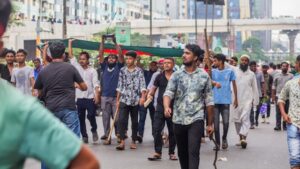
More than one hundred and fifty thousand people have died in just two years. Over twelve million people have left their homes. Children are dying from hunger. Women are being terribly raped. Whole communities are being wiped out. Shocking to hear? But this is not a story from the past. In this modern world, these horrible things are happening right now in Sudan — and the world? You could say it is just watching silently like an audience.
Since April 2023, a deadly civil war has been going on between the Sudanese Armed Forces (SAF) and the paramilitary Rapid Support Forces (RSF). The United Nations calls it “the world’s biggest humanitarian crisis,” and every day it is getting worse. Yet, there is almost no news about this genocide in international media, and global politics seems to care very little. Honestly, I’m confused — or am I missing something? Except for a few major news outlets, I haven’t seen anyone reporting on it. If I’m wrong, please correct me. But why is this happening? Is it because they are African, black, or poor? This silence is not only dangerous — it is a form of supporting the crime itself.
When Hope Turned Into Fear
To understand today’s disaster and violence, we need to look back a little. In 2019, the people of Sudan removed Omar al-Bashir, who had ruled the country for 30 years. Young people led this huge movement, and many women took part with great courage. Their actions caught the attention of the whole world. For a short time, it seemed like democracy might finally come to Sudan.
But in 2021, two army leaders General Abdel Fattah al-Burhan from the Sudanese Army and General Mohamed Hamdan Dagalo (Hemetti) from the Rapid Support Forces (RSF) took power together, and people’s hopes were broken again. Later, when a foreign-supported political plan threatened their control, they turned against each other. On April 15, 2023, their fight for power became a bloody war.
The RSF came from the Janjaweed militia, known for the genocide in Darfur in the early 2000s. Now that dark history has returned, even worse than before. Neither the SAF nor the RSF represents the people’s dream of democracy. Both sides are breaking international human rights laws, but the RSF’s actions in Darfur clearly show signs of genocide.
A crisis that is hard to understand
Have you seen the numbers of the affected? The numbers are terrible. We only see the numbers, but behind each number there is a human story, a family story. Already one hundred fifty thousand people have been killed. Twelve million people have been displaced, which is about one quarter of Sudan’s total population. Of them, about nine million are internally displaced in the country, and more than three million have fled to neighboring countries.
If you notice, this violence is planned and targeted. In Darfur, the RSF and their allied Arab militias are regularly attacking non-Arab groups, such as the Masalit and Zaghawa communities, with brutal attacks. Villages are being burned one after another, men and boys are being killed, women are being raped, to frighten and drive away whole communities.
A terrible situation developed after the fall of El Fasher, the last military base in Darfur. After an 18-month blockade, hunger and bombing, the RSF took control of the city. More than sixty thousand people fled, and according to the UN refugee agency, they all described horrible abuse, especially rape. About one hundred fifty thousand people are still trapped in the city, and their future remains uncertain.
UN representative Eugene Bayun said that those who survived and reached the town of Tawila from El Fasher, every child is suffering from malnutrition. This is not a side effect of war. It is a deliberate tactic to keep people hungry and slowly eliminate them. The purpose of the 18-month blockade was to destroy the city’s people through hunger and violence.
Gender-based violence has now become routine there. Women who survived say they were raped, gang-raped, and forced into sexual slavery. These attacks are done openly and deliberately, to break whole societies.
BBC Verify identified an RSF militiaman. That man, named Abu Lulu, himself killed several unarmed men and posted the video on social media. After the international media reported it, he was arrested, but this is not justice; it is an attempt to hide shame temporarily. TikTok later closed that account. Such videos prove that the killers know they will not be punished.
This is genocide
The RSF claims that their violence is not ethnic. But the real evidence says the opposite. According to the 1948 UN Genocide Convention, killing, harming, or creating life-threatening conditions to destroy a national, racial, religious, or ethnic group is called genocide.
The violence in Sudan fits exactly into this definition. Planned attacks on non-Arab communities, destroying their villages one by one, using rape as a weapon of ethnic cleansing, keeping people hungry — all these prove this is not a normal war, it is genocide.
The siege of El Fasher is a major example of that. For 18 months, the city was surrounded, food was blocked, and bombing destroyed unarmed civilians. Every child’s malnutrition proves it — this is planned genocide.
Survivors have clearly said they were killed only because of their ethnic identity. In videos, we can see unarmed men being shot dead because they belong to the targeted group. This is clear genocide, with proof. There is no way to deny it.
The world’s moral failure
But the most terrible thing is — the world knows everything, yet does nothing, absolutely nothing. No action is taken. The United Nations itself says this is the world’s biggest humanitarian crisis. But strangely, Sudan still gets little attention and help compared to other wars. Why? Is their “TRP” lower?
The UN’s humanitarian aid fund is not even half full. It shocks us that when 60,000 people flee from genocide, it gets very little coverage in the news. When 150,000 people are trapped, the whole world stays silent. Aid groups say they cannot provide enough food and shelter, saying there is no money — but is that really true? Or is it a lack of political will?
Why is this happening? Sudan has no big allies, less geopolitical importance, and in global politics, African lives have always been considered less valuable. It sounds harsh, but this is the bitter truth. The media that spends hours covering other wars almost ignores Sudan.
The UN Security Council is useless, divided by national interests. Sanctions are weak and ineffective. The International Criminal Court only gives statements but has no power to act. Neighboring countries are busy with their own interests — Egypt supports the SAF, and the United Arab Emirates is accused of giving weapons and diplomatic help to the RSF.
Meanwhile, killing continues, hunger continues, rape continues — and the world sits discussing “funding shortages” and “diplomatic complications.” What a tragic fate for the people of Sudan!
Now is the time to act
The solutions are not unknown to us. The world must act now, right now—
1. Humanitarian aid: The one hundred fifty thousand people trapped in El Fasher must be rescued and protected. Create food and medical corridors under international protection. Fully fund the aid agencies.
2. Arms embargo: Stop supplying weapons to both sides. Hold accountable those who send weapons from outside countries.
3. Diplomatic pressure: Not just “express concern”—if the violence continues, impose real punishments and sanctions.
4. Justice and accountability: Bring those involved in genocide and crimes against humanity before international courts.
5. Media coverage: The media must report on this crisis regularly and deeply. When genocide is seen directly, ignoring it is also a crime.
These require political will, which I still do not see. But it must change. It must change.
Why you should care
You may be thinking — “There are so many problems, what can I do alone?” Okay, but you can be aware. You can learn. You can tell others. You can tell your government to stand with the people of Sudan. You can support the organizations working there. You can speak up instead of staying silent.
Sudan matters because the lives of one hundred fifty thousand people matter. The lives of twelve million displaced people matter. The life of the woman who escaped El Fasher after rape matters. The life of the hungry child matters. They are not numbers. They are people. They have the same right to live well as you.
In 2019, the people of Sudan showed great courage and demanded freedom. Their dream was ruined by warmongers, and the world forgot them. But they deserve better than this.
One question stands before us now
To ignore Sudan is to deliberately value some lives less than others. It means we know genocide is happening and still stay silent. It means claiming human rights on paper but denying them in practice.
We are all witnesses now. At the fall of El Fasher, when children are dying of hunger, when people are being shot— we know what is happening. History will one day ask — what did you do then?
The trapped people cannot wait. The hungry children cannot wait. The women who were raped cannot wait for justice. Every day of delay means more deaths. Every silence makes you a partner.
The world must act now, with aid, resolve, and moral courage. The time for silence is over. Now is the time to act.
What you can do: Learn about Sudan. Tell others. Tell your representatives to take action. Support those doing humanitarian work in Sudan. Do not let this genocide disappear. Your voice matters — use it.