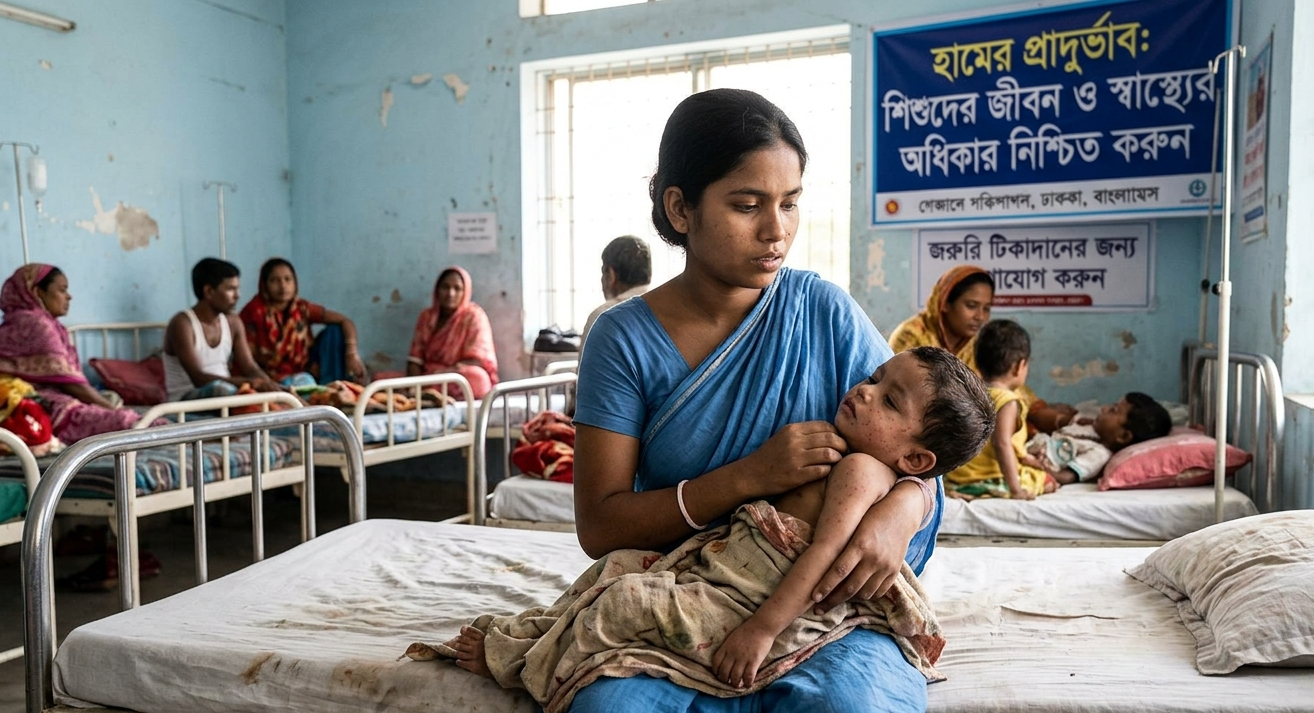
Bangladesh was once known as a model to the world for the success of its vaccination program. But in March 2026, a measles outbreak across the country has put that achievement under serious challenge. According to government data, 676 children have been confirmed with measles in the first three months of this year—75 times higher than the same period last year. According to hospital sources, at least 34 to 46 children have died, with 21 to 32 deaths occurring in March alone. In Dhaka’s Infectious Diseases Hospital, 15–21 children have lost their lives.
This crisis is a result of the lack of continuity in health sector planning and management under the Interim Government following the political changes in August 2024. The collapse of the vaccine supply system, the breakdown of the vaccination program, and the neglect of child health have turned this into not just a health crisis, but a clear violation of human rights regarding children’s right to life and health.
Picture of the Current Crisis: Data and Statistics
According to Directorate General of Health Services (DGHS) data, there are 676 measles cases in the first three months of 2026—a massive increase compared to 9 cases last year. In the whole year of 2025, only 125 cases were recorded. The pressure on hospitals is unbearable: 450 suspected patients have been admitted to Dhaka’s Infectious Diseases Hospital since January, 70 percent of whom are confirmed measles; 12 children died at Rajshahi Medical College Hospital, 5 in Mymensingh, 3–4 in Chapainawabganj, and 6 children at Dhaka Shishu Hospital. Prothom Alo (31 March 2026) reported that 21 child deaths were reported in March alone. The Business Standard and TBS News (31 March 2026) mentioned that the infection has spread to seven divisions of the country, especially Dhaka, Rajshahi, Mymensingh, and Chattogram.
The following table shows a summary of the crisis:
| Period | Confirmed Cases | Child Deaths (Estimated) |
| Full year 2025 | 125 | — |
| First 3 months of 2026 | 676 | 34–46 |
| March 2026 |
Data not available separately |
21–32 |
Due to malnutrition and weak immunity, children are facing complications—including pneumonia and encephalitis. Experts say one infected person can infect 15–18 people. In 2025, MR (Measles-Rubella) vaccine coverage dropped to 57.1 percent—the lowest in eight years.
Interim Government’s Mismanagement: Main Cause of Vaccine Crisis
During the Interim Government (from August 2024), the health sector planning system (HPNSP) was suddenly cancelled in August 2025 without any alternative preparation. As a result, the vaccine purchase, transport, and distribution system collapsed. Stocks of six important vaccines, including MR, are now zero in the central vaccine warehouse. Prothom Alo (31 March 2026) reported that EPI officials admitted there are no vaccines at the district-upazila level. 1,326 porters have stopped working after not receiving salaries for nine months; 45 percent of health workers are absent in 37 districts.
A special vaccination campaign in June 2024 was postponed due to political unrest. No alternative campaign was conducted during the Interim Government’s time. The Daily Star editorial (31 March 2026) mentioned that the vaccination system has broken down. Public health experts Professor Be-Nazir Ahmed and Dr. Tajul Islam Bari told TBS News that it is impossible to control measles without 90–95 percent coverage; in 2025, coverage fell below 70 percent.
Human Rights Perspective: Violation of Child Rights
This crisis is a direct violation of international human rights law. In Article 6 of the UN Convention on the Rights of the Child (UNCRC), the child’s right to survival and development is protected; Article 24 ensures the right to the highest standard of health care and vaccination. Article 12 of the International Covenant on Economic, Social and Cultural Rights (ICESCR) gives the state the responsibility to prevent infectious diseases. The right to health care for citizens is also recognized in Article 15(a) of the Bangladesh Constitution.
The Interim Government’s mismanagement has harmed these fundamental rights of children. Thousands of children have remained unvaccinated—this is proof of the lack of state responsibility. According to human rights organizations, child death from preventable diseases is a clear sign of state negligence. Although UNICEF and the World Health Organization (WHO) warned repeatedly, no effective steps were taken.
International Media and Reaction
International English newspapers have given importance to this crisis. The Straits Times (30 March 2026) and Channel News Asia reported that the Prime Minister has ordered an investigation, but the root of the crisis is the unrest of 2024–25 and vaccine supply failure. Xinhua (30 March 2026) wrote, “Immunization gaps and malnutrition are increasing child deaths.” DD News and The Peninsula Qatar also reported in the same tone.
Way to Solution: Urgent Steps and Accountability
The government must immediately release 604 crore BDT allocated for vaccine purchase. It is urgent to start a national vaccination campaign on an emergency basis, recruit field-level workers, and pay the salaries of porters. Stocks must be filled using assistance from UNICEF and Gavi. In the long term, a stable system like HPNSP needs to be restored and training for health workers should be increased.
Human rights organizations should demand an independent investigation. Accountability of officials responsible for child deaths must be ensured.
Conclusion: Unite to Protect the Future of the Child
Children are losing their lives due to the measles outbreak during the Interim Government—this is not just a failure of the health system, but a question of state responsibility regarding human rights. If Bangladesh fails to protect child rights, the dream of development is meaningless. Government, civil society, international organizations, and people must work together. If the vaccination system is not rebuilt, many more children will be lost. The time has come for accountability and recovery. The children of Bangladesh only want the right to live—it is the state’s responsibility to ensure that.
(Word count: approximately 1150. This article is written with the aim of increasing awareness and protecting human rights.)
References
- Prothom Alo. (2026, March 31). Measles outbreak claims lives of children. Prothom Alo. Available at: https://en.prothomalo.com/bangladesh/t7gt89boos .
- The Daily Star. (2026, March 31). Measles vaccination being hobbled by neglect [Editorial]. The Daily Star. Available at: https://www.thedailystar.net/opinion/editorial/news/measles-vaccination-being-hobbled-neglect-4139251 .
- The Business Standard/TBS News. (2026, March 31). Measles cases surge in Bangladesh. The Business Standard. Available at: https://www.tbsnews.net/bangladesh/health/measles-cases-bangladesh-surged-75-fold-compared-last-year-dghs-data-1398636 .
- Xinhua. (2026, March 30). Vaccine gaps, malnutrition fuel child deaths in Bangladesh. Xinhua (content mirrored in international reports). Available at: https://ddnews.gov.in/en/bangladesh-measles-outbreak-vaccine-gaps-malnutrition-fuel-child-deaths/
- Directorate General of Health Services (DGHS), Bangladesh. (2026). Official measles data (January–March). DGHS official statistics (cited across multiple sources). Available at: https://www.tbsnews.net/bangladesh/health/measles-cases-bangladesh-surged-75-fold-compared-last-year-dghs-data-1398636 .