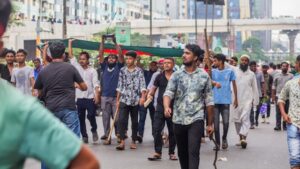
A very cruel event recently happened in Bangladesh. It has badly shaken our society, the state, and the situation of human rights. In Bhaluka, Mymensingh, a man was publicly beaten, hung from a tree, and then burned to death after people accused him of making religious insults. The victim was Dipu Chandra Das. He was a garment worker, the only person earning money for his family, and the father of a one-year-old baby.
The incident took place in the Jamirdia Dubalia Para area, in front of the Paoniwa BD Limited Section-3 factory. Dipu lived in Tarakanda and had been working at that factory for a long time.
A Family Destroyed in a Moment
Dipu Chandra Das was the only hope for his family. His father is physically disabled and paralyzed after an accident. Witnesses said the father was crying helplessly during the incident. Dipu’s wife and baby are now facing a completely uncertain future.
According to the family, Dipu was educated and had a BA degree. They believe that because of some argument inside the factory, someone planned and spread a false religious accusation against him. Using that as an excuse, people stripped him, beat him cruelly, and finally burned him to death.
- Also Read: Mob Violence: From the Right to Life to the Right to Education — A Family Doubly Victimized
This is Not New, and Not the End
The scariest part is that this is not the first time, and there is no guarantee it will be the last. In recent years, religious extremism and violence have clearly increased in Bangladesh. People use religious complaints to settle personal fights, social hate, or political goals.
Reports say that in just one and a half years after the political change, more than 2,000 minority family have faced attacks and violence. In most of these cases, religious accusations were used as a weapon for violence.
In the past year (late 2024 through 2025), reports from human rights organizations and minority advocacy groups indicate a significant rise in communal and political violence targeting minority communities in Bangladesh.
The primary data comes from the Bangladesh Hindu Buddhist Christian Unity Council (BHBCUC) and other international human rights monitors: youtube link.
Consolidated Statistics (August 2024 – Late 2025)
| Category | Documented Incidents | Period Covered |
| Total Communal Attacks | 2,442 | Aug 4, 2024 – June 30, 2025 |
| Murders | 27+ | Jan – June 2025 (Partial data) |
| Attacks on Places of Worship | 152+ | Since Aug 2024 |
| Sexual Assault / Rape | 20+ | Jan – June 2025 (Partial data) |

Rumors and Mob Justice: The Opposite of Law
In these cases, we see a person is called “guilty” without any proof, investigation, or legal process. Rumors and angry crowds lead to terrible violence in a second.
According to the law, if there is a complaint, the court should handle it. No one has the right to beat, burn, or kill someone in public. When a mob starts doing the “justice” themselves, the law of the country becomes useless.
International Law and UNHCR’s View
This killing is not just against the Bangladesh Constitution; it also breaks international human rights laws.
According to the United Nations Universal Declaration of Human Rights (UDHR):
Also, the ICCPR (which Bangladesh signed) promises to protect life and religious freedom. While UNHCR mostly works for refugees, they also stand for the safety of religious minorities and victims of violence. Killing someone for their religion is a very serious crime globally. Such violence makes people flee their homes and become refugees.
If this continues, it will badly hurt Bangladesh’s reputation regarding human rights on the international stage.
Responsibility and Failure of the State
The Constitution says every citizen has the right to life, safety, and religion. But Dipu’s murder shows how risky these rights are in reality.
The questions remain:
Why can’t this violence be stopped in time?
Why do the police and law agencies often stay silent?
Why do the people involved in religious violence get away with it again and again?
Until we get these answers, such incidents will not stop.
The Silence of Society is a Problem
Besides the state, the silence of the people makes this violence stronger. We protest for a few days and then forget everything. This silence makes the criminals more brave. When burning a human becomes “normal” in society, it is a scary message not just for minorities, but for everyone.
Conclusion
The murder of Dipu Chandra Das clearly tells us that human rights, safety for minorities, and the rule of law are in a deep crisis in Bangladesh. Killing someone in the name of religion is never acceptable—not by law, and not by humanity.
There must be a fast and fair trial for this. The state must show that no one can take the law into their own hands. Human rights are for everyone. If we stay quiet today, anyone could be the victim tomorrow.