ABSTRACT
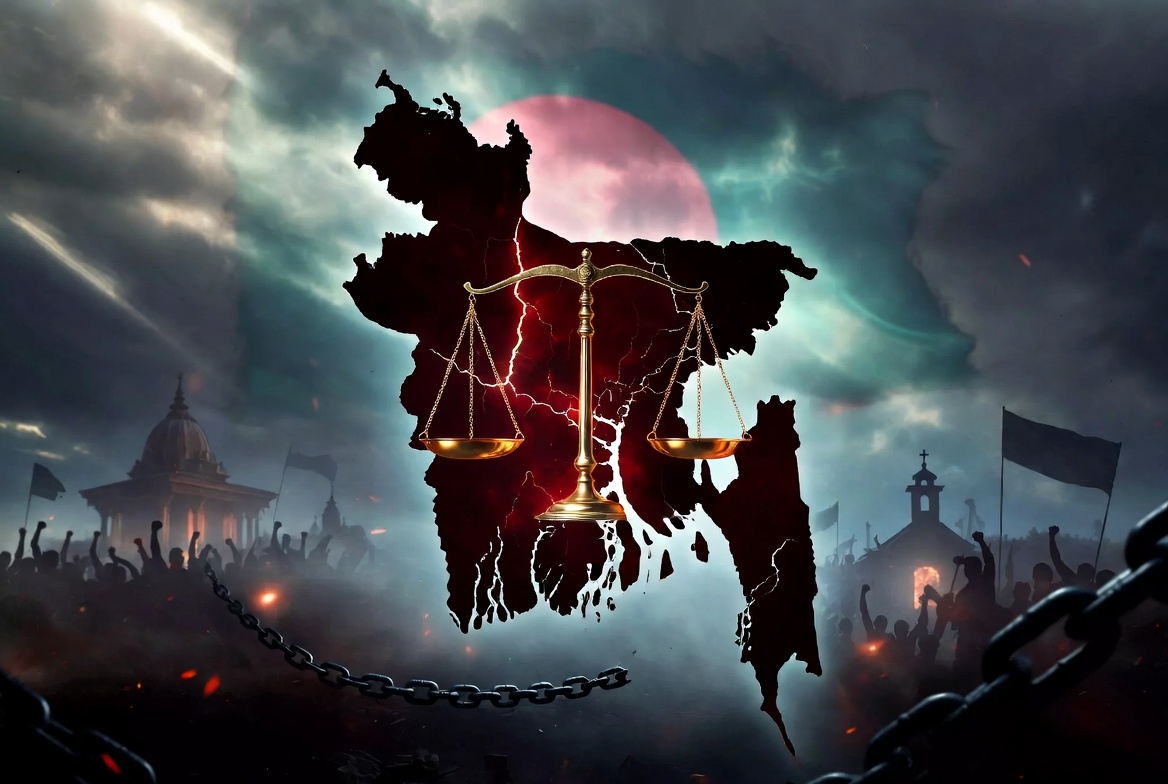
Bangladesh’s 2024 student uprising ended Sheikh Hasina’s fifteen-year government and generated widespread expectation of democratic renewal. This article argues that such renewal has not materialised. Drawing on data from six independent human rights organisations — Ain o Salish Kendra (ASK), Odhikar, the Human Rights Support Society (HRSS), the Bangladesh Hindu Buddhist Christian Unity Council (BHBCOP), Human Rights Watch, and Amnesty International — and employing a Transitional Justice analytical framework, the article demonstrates that three structural pathologies persist across both the interim (August 2024–February 2026) and BNP-led (February 2026–present) governments: the displacement of state violence by non-state mob violence; the disproportionate and escalating persecution of religious and ethnic minorities; and a culture of impunity reinforced by institutional fragility, judicial deference, and deliberate under-reporting. The article rejects optimistic incrementalism as a sufficient response, argues that Bangladesh exhibits characteristics of a ‘transitional impunity trap’, and proposes targeted institutional, legislative, and civic reforms grounded in comparative transitional justice evidence.
KEYWORDS
Bangladesh · mob violence · transitional justice · minority persecution · impunity · human rights · democratic transition · blasphemy laws
1. Introduction: The Promise and the Reckoning
On 5 August 2024, Sheikh Hasina fled Bangladesh following weeks of mass protests led primarily by students. The uprising ended fifteen years of Awami League governance marked by enforced disappearances, extrajudicial killings, and systematic suppression of political opposition (Human Rights Watch, 2026; Amnesty International, 2025–2026). A Nobel Peace Laureate, Muhammad Yunus, assumed leadership of an interim government, and the international community offered cautious optimism.
That optimism now requires critical reappraisal. More than twenty months after the uprising, and following national elections in February 2026 that brought the Bangladesh Nationalist Party (BNP) to power, credible empirical data reveals not the consolidation of rights protections, but their transformation. State-sponsored repression has been partially displaced by non-state mob violence. Minorities who faced neglect under previous administrations now face active persecution. Institutional reforms remain superficial, courts have shown troubling leniency toward perpetrators of communal violence, and civil society organisations documenting abuses report systematic under-reporting by official bodies.
This article proceeds in seven parts. Section 2 locates the analysis within Transitional Justice scholarship, arguing that Bangladesh exhibits features of what this article terms a ‘transitional impunity trap’. Sections 3 through 5 present the empirical record on mob violence, minority persecution, and state actor conduct respectively. Section 6 examines two emblematic cases from late 2025 and early 2026. Section 7 assesses international legal obligations. Section 8 offers evidence-grounded recommendations, and Section 9 concludes.
2. Theoretical Framework: The Transitional Impunity Trap
Transitional Justice scholarship — encompassing the foundational work of Ruti Teitel (2000), the empirical contributions of Kathryn Sikkink (2011), and the institutional analyses of Pablo de Greiff (2012) — posits that post-authoritarian societies face a critical window in which the treatment of past abuses shapes future institutional norms. Teitel’s ‘transitional rule of law’ concept is particularly relevant: when transitional governments selectively prosecute abuses for political rather than justice-oriented reasons, they reinforce rather than dismantle cultures of impunity.
Bangladesh’s post-2024 trajectory exhibits three features that together constitute what this article calls a ‘transitional impunity trap’. First, there is the substitution effect: state violence, having become politically costly, is displaced by non-state violence which the state tolerates or fails to deter. Second, there is institutional capture: reform commissions are established but under-resourced and denied prosecutorial independence, functioning as legitimating performance rather than genuine accountability. Third, there is minority vulnerability escalation: political transitions historically correlate with spikes in communal violence against minorities (Wilkinson, 2004; Brass, 2003), and Bangladesh’s post-2024 period is consistent with this pattern.
This framework explains a phenomenon that optimistic accounts cannot: why formal democratic progress — elections held, commissions established, international conventions ratified — coexists with worsening violence against the most vulnerable. The trap lies precisely in the appearance of reform: each institutional gesture reduces international pressure while actual accountability mechanisms remain inoperative.
3. The Rise of Non-State Mob Violence
3.1 Scale and Trajectory
The most statistically dramatic feature of Bangladesh’s post-uprising human rights situation is the sharp escalation in mob violence deaths. ASK documented 128 mob violence deaths in 2024, rising to at least 197 in 2025 — a 54 per cent increase in a single year (Ain o Salish Kendra, 2025a). Across the full interim government period (August 2024 to February 2026), ASK recorded 293 mob-related deaths. HRSS data, using a broader definitional scope, recorded 168 deaths and 248 injuries across 292 mob violence incidents in 2025 alone (HRSS, 2026b). January 2026 recorded 21 mob killings — a monthly rate that, if sustained, would produce an annual death toll exceeding 250 (HRSS, 2026a).
Dhaka division consistently registers the highest incidence, which is consistent with population density and the documented weakness of local policing infrastructure. However, incidents are geographically dispersed, occurring across rural upazilas as well as urban centres, suggesting systemic rather than localised causes.
3.2 Structural Drivers
Mob violence in post-2024 Bangladesh is driven by at least three intersecting structural factors. First, religious blasphemy allegations — frequently based on old, decontextualised, or fabricated social media content — serve as a recurring mobilisation mechanism. The speed of digital propagation means that crowds can assemble before law enforcement responds, and the gravity of the accusation creates a social environment in which intervention is politically costly for local officials.
Second, the banning of the Awami League in May 2025 created a political vacuum and a context of permissible revenge. Individuals associated with the previous government, or perceived to be so associated, became vulnerable to mob-based extrajudicial retribution that operates outside and in defiance of formal legal processes.
Third, there is a general decline in public trust in the judiciary and police. When citizens believe that formal justice is slow, partial, or unavailable, the psychological and social barriers against mob justice diminish. This is consistent with the broader Transitional Justice literature: Sikkink (2011) demonstrates that impunity norms, once established, become self-reinforcing through exactly this mechanism.
3.3 The State’s Inadequate Response
The pattern of state response has been remarkably consistent: senior officials issue post-incident statements; cases are filed with large numbers of unnamed suspects; and arrests, when made, are slow and rarely result in prosecution. This response pattern is not merely ineffective — it is structurally enabling. It creates the credible expectation among potential mob participants that consequences are unlikely, which is the definitional condition for impunity to function as a behavioural incentive rather than a deterrent.
4. The Persecution of Religious Minorities: Disproportionate and Escalating
4.1 The Empirical Record
BHBCOP’s annual communal violence review for 2025 documents 522 communal attacks resulting in 66 deaths, 28 incidents of sexual violence against women and girls (including rape and gang rape), 95 attacks on temples, churches, and other places of worship, and 102 assaults on homes and businesses (BHBCOP, 2026). For January to March 2026, BHBCOP recorded 133 further incidents, including 25 killings and 35 attacks on places of worship — a pace suggesting continued escalation into the new electoral period (HRSS, 2026a).
The government’s own figure of 71 communal incidents for 2025 — less than 14 per cent of the BHBCOP total — illustrates the severity of the official under-reporting problem. This divergence is not merely a definitional dispute: it reflects a systematic institutional incentive to minimise communal violence in official records, consistent with the ‘institutional capture’ dynamic identified in Section 2.
4.2 The Historical Pattern and Its Current Intensification
The persecution of Hindus, Christians, and indigenous communities in the Chittagong Hill Tracts is not new to Bangladeshi political history. Scholars including Willem van Schendel (2009) and Ali Riaz (2016) have documented recurring cycles of anti-minority violence correlated with political transitions — most notably in 1971, in the aftermath of the 2001
elections, and following the 2013–2014 political crisis. The current episode shares structural features with these historical antecedents: political instability, the weakening of protective state institutions, and the exploitation of minority vulnerability as a vehicle for communal mobilisation.
What distinguishes the present period is the convergence of this historical pattern with the displacement of state violence described in Section 3. Under previous governments, minorities faced administrative neglect and selective enforcement. Under the current conditions, they face active communal violence in a context where the state’s capacity and political will to protect them are simultaneously diminished.
4.3 Gender Dimensions
BHBCOP’s documentation of 28 incidents of sexual violence against minority women in 2025 demands specific analytical attention. Sexual violence in communal conflict is rarely random — it functions as a tool of communal humiliation and displacement, targeting women’s bodies as a site of collective degradation (Das, 2007; Wood, 2009). The systematic under-prosecution of these offences reinforces their utility as a communal weapon and constitutes a distinct failure under Bangladesh’s obligations under the Convention on the Elimination of All Forms of Discrimination Against Women (CEDAW).
5. State Actors and the Persistence of Extrajudicial Practices
The reduction in overtly politically-motivated state repression should not obscure the documented continuation of extrajudicial practices by law enforcement. Odhikar’s quarterly report for July to September 2025 documented 40 extrajudicial killings by security forces between August 2024 and September 2025, of which 19 involved death by gunfire, 14 involved torture, and 7 involved fatal beatings in custody (Odhikar, 2025a). HRSS recorded a further 39 custodial deaths in the first quarter of 2026 alone (HRSS, 2026a). ASK documented 38 extrajudicial killings by security forces across 2025 (Ain o Salish Kendra, 2025a).
The use of the Anti-Terrorism Act against journalists, perceived political opponents, and individuals associated with the previous government reflects the continuation of a legislative tool that human rights organisations have consistently identified as susceptible to political misuse. Al Jazeera’s November 2025 investigation into extrajudicial killings under the Yunus government documented continued practice of ‘crossfire’ killings — a euphemism for
extrajudicial execution that Bangladeshi security forces have employed for decades (Al Jazeera, 2025).
The interim government did take some institutional steps that merit acknowledgement. The establishment of an Enforced Disappearances Commission, Bangladesh’s accession to the International Convention for the Protection of All Persons from Enforced Disappearance, and the passage of the National Human Rights Commission (NHRC) Ordinance 2025 represent formal progress. However, applying Teitel’s framework, these institutional gestures function primarily as legitimating performances if not accompanied by operational independence, adequate funding, and genuine prosecutorial capacity. The evidence available through April 2026 does not suggest this threshold has been met.
6. Two Emblematic Cases: Normalisation and Judicial Leniency
6.1 The Kushtia Pir Killing (11 April 2026)
In Philipnagar village, Daulatpur upazila, Kushtia district, a mob attacked the darbar of Sufi spiritual leader Abdur Rahman — also identified in some reporting as Shamim Reza or Jahangir, aged approximately 65 — following the circulation of an old video alleged to contain remarks disrespectful of the Quran (The Daily Star, 2026a; The Business Standard, 2026). Despite a reported police presence, the spiritual leader was beaten and hacked to death, at least three devotees sustained injuries, and the darbar compound was set on fire.
A case was subsequently filed against one named individual and approximately 200 unnamed suspects (The Business Standard, 2026). No arrests were made within the first days after the killing. The victim’s family reportedly declined to pursue the case vigorously, citing fear of reprisals — a chilling effect that is itself a structural feature of impunity (The Daily Star, 2026b). The killing illustrates three analytically significant patterns: the use of social media to mobilise violence against religious figures who deviate from majoritarian orthodoxy; the failure of police presence to function as a deterrent; and the near-total impunity that follows.
6.2 The Lynching of Dipu Chandra Das and Its Aftermath (December 2025–April 2026)
On 18 December 2025, Dipu Chandra Das, a Hindu garment worker employed in Bhaluka, Mymensingh, was dragged from his factory, beaten, paraded publicly, tied to a tree, and burned alive following blasphemy accusations. A subsequent investigation by the Rapid Action
Battalion confirmed that no evidentiary basis existed for the blasphemy allegation (Wikipedia, 2026).
The case’s subsequent judicial trajectory is as significant as the killing itself. In mid-April 2026, one of the principal accused received interim bail from the High Court — a development that prompted nationwide protests and human chain formations by Hindu communities (HRSS, 2026a). This judicial outcome is analytically consistent with the ‘transitional impunity trap’: the formal legal system, rather than serving as the ultimate backstop against communal violence, became a vehicle for its effective legitimation. When the judiciary extends procedural protections to perpetrators of mob killings in ways that permit their rapid return to the communities they terrorised, it signals to both perpetrators and potential victims that accountability is illusory.
The Dipu Chandra Das case is not an anomaly — it is an illustration of how the formal legal architecture, absent genuine accountability culture, can be mobilised to sustain rather than disrupt cycles of impunity.
Read The Article: Mob Lynching and Burning in the Name of Religious Allegations
7. International Legal Obligations: Gaps and Failures
Bangladesh’s binding obligations under international human rights law provide a clear external standard against which its current conduct can be measured. The pattern of violations documented above engages at minimum the following obligations.
Under the International Covenant on Civil and Political Rights (ICCPR), to which Bangladesh acceded in 2000, Articles 6 and 7 — guaranteeing the right to life and prohibiting torture — are engaged by every documented extrajudicial killing and custodial death. Article 9 (liberty and security of person) is engaged by arbitrary detention practices. Article 18 (freedom of thought, conscience, and religion) is engaged by the weaponisation of blasphemy allegations as a mob-mobilisation tool. Article 27 — which provides that members of ethnic, religious, and linguistic minorities shall not be denied the right to enjoy their own culture, practice their own religion, and use their own language — is engaged by the systematic pattern of communal attacks documented in Section 4.
The Convention Against Torture, ratified by Bangladesh in 1998, is engaged by the 14 documented cases of death by torture in custody identified by Odhikar (2025a). The UN Paris Principles, which govern the adequacy of national human rights institutions, set standards of independence and effectiveness that the NHRC Ordinance 2025, as currently constituted, does not demonstrably meet.
Comparative evidence from other transitional democracies — Tunisia’s post-2011 Truth and Dignity Commission, South Africa’s post-apartheid Truth and Reconciliation Commission, and the more troubled experience of Egypt after 2011 — consistently shows that compliance with these standards is not merely aspirational but operationally determinative: states that establish genuinely independent accountability mechanisms see measurable reductions in recurring violations; those that establish performative institutions do not (de Greiff, 2012; Sikkink, 2011). Bangladesh’s current trajectory resembles the latter more closely than the former.
8. Structural Recommendations
The following recommendations are grounded in the empirical and theoretical analysis above. They are distinguished from generic policy prescriptions by their specificity and their grounding in the structural diagnosis offered in Section 2.
8.1 Breaking the Institutional Capture Dynamic
The NHRC must be restructured to meet Paris Principles standards of operational independence. This requires commissioner selection through a genuinely independent process, insulated from executive influence; a budget line that is constitutionally guaranteed or at minimum legislatively ring-fenced; and prosecutorial referral powers that create real accountability pathways rather than advisory functions. Without these features, the NHRC functions as legitimation of impunity rather than remedy for it.
8.2 Disrupting the Blasphemy-Violence Pipeline
The weaponisation of blasphemy allegations as a mob-mobilisation tool requires a specific, targeted response. This should include: the creation of a rapid-response digital monitoring unit with authority to flag and refer for prosecution the circulation of demonstrably false blasphemy allegations; amendment of the Digital Security Act to criminalise the deliberate propagation of fabricated blasphemy content; and mandatory minimum sentencing guidelines for mob violence convictions that remove judicial discretion to grant bail to principal accused in cases involving death.
8.3 Minority Protection as a Structural Priority
The gap between official figures (71 communal incidents) and civil society documentation (522 incidents) in 2025 reflects systematic institutional failure that requires structural correction. A minority protection mechanism with dedicated police units, mandatory incident reporting
to an independent body, and automatic referral of sexual violence cases to a specialist prosecutorial unit would begin to address this gap. Bangladesh should additionally engage the UN Special Rapporteur on Minority Issues and invite a country visit, converting international scrutiny from an external pressure to a governance resource.
8.4 Transitional Justice for the Uprising Period
The violence of the 2024 uprising and its immediate aftermath — including documented security force killings, arbitrary detentions, and communal attacks — requires a genuine truth-seeking and accountability process rather than selective prosecution driven by political interest. A time-limited, independent commission modelled on South Africa’s TRC, with a specific mandate covering August 2024 to February 2026, would begin to establish the accountability norm that the current institutional landscape lacks.
9. Conclusion: Accountability as a Structural Prerequisite
Bangladesh’s 2024 uprising was a moment of genuine collective agency — citizens demanding accountability, dignity, and rule of law at extraordinary personal risk. The analysis presented in this article demonstrates that the structures against which they protested have proven more durable than the uprising itself. Mob violence has risen sharply; minority communities face escalating persecution; extrajudicial killings continue; and the judiciary has in emblematic cases reinforced rather than disrupted cycles of impunity.
The ‘transitional impunity trap’ framework offered here explains this persistence: it is not accidental, but structural. Institutions designed to appear reformist while preserving operational impunity are a stable equilibrium, not a temporary imperfection. Breaking that equilibrium requires institutional changes of a kind that impose genuine costs on powerful actors — changes that no government undertakes willingly without sustained domestic and international pressure.
The international community’s role is therefore not peripheral but constitutive. Scholarship committees, development financiers, trade partners, and human rights treaty bodies each exercise leverage that, deployed with consistency and specificity, can alter the cost-benefit calculation for accountability-resistant governments. The question is not whether the international community is ‘watching’ Bangladesh — it is whether it is prepared to act on what it sees.
For Bangladesh itself, the stakes are existential for its minority communities, its rule of law infrastructure, and its democratic legitimacy. A nation that won independence on a founding promise of secularism, equality, and human dignity cannot sustain that promise while tolerating the burning alive of garment workers on fabricated charges and the judicial rehabilitation of those responsible. The choice is between accountability as policy and impunity as governance — and that choice, made incrementally through each institutional decision, each court ruling, and each mob left unprosecuted, is being made now.
REFERENCES
PRIMARY EMPIRICAL SOURCES:
Ain o Salish Kendra (ASK). (2025a, December 31). Human rights situation in Bangladesh 2025: Annual observations. Dhaka: Ain o Salish Kendra. Ain o Salish Kendra (ASK). (2025b, August 12). Mob violence report: January–August 2025. Dhaka: Ain o Salish Kendra. Bangladesh Hindu Buddhist Christian Unity Council (BHBCOP). (2026, January 30). Annual communal violence review 2025. Dhaka: BHBCOP. Human Rights Support Society (HRSS). (2026a, April). Human rights situation in Bangladesh: January–March 2026 (Q1 quarterly report). Dhaka: HRSS. Human Rights Support Society (HRSS). (2026b, February). Human rights situation in Bangladesh: September 2024–January 2026. Dhaka: HRSS. Human Rights Support Society (HRSS). (2026c, January). Human rights situation in Bangladesh — January 2025 (monthly report). Dhaka: HRSS. Retrieved from hrssbd.org. Odhikar. (2025a, October 30). Quarterly human rights report: July–September 2025. Dhaka: Odhikar. Odhikar. (2025b). Annual human rights report 2024. Dhaka: Odhikar. Retrieved from https://odhikar.org/ahrr-2024_odhikar_english/
INTERNATIONAL ORGANISATION REPORTS
Amnesty International. (2025–2026). Bangladesh: Annual report and country updates 2025–2026. London: Amnesty International. Retrieved from https://www.amnesty.org/en/location/asia-and-the-pacific/south-asia/bangladesh/ Human Rights Watch. (2026, February 8). World report 2026: Bangladesh. New York: Human Rights Watch. Retrieved from https://www.hrw.org/world-report/2026/country-chapters/bangladesh
NEWS AND MEDIA SOURCES
Al Jazeera. (2025, November 13). New rulers, old killers: Bangladesh extrajudicial deaths mount under Yunus. Retrieved from https://www.aljazeera.com/features/2025/11/13/have-extrajudicial-killings-continued-under-bangladeshs-yunus-government The Business Standard. (2026, April 14). Kushtia pir killing: Case filed against one named, 200 unidentified suspects. Dhaka: The Business Standard. Retrieved from https://www.tbsnews.net The Daily Star. (2026a, April 11). Mob hacks pir to death in Kushtia. Dhaka: The Daily Star. Retrieved from https://www.thedailystar.net The Daily Star. (2026b, April 15). Bring Kushtia pir’s killers to justice [Editorial]. Dhaka: The Daily Star. Retrieved from https://www.thedailystar.net
SCHOLARLY LITERATURE
Brass, P. R. (2003). The production of Hindu-Muslim violence in contemporary India. University of Washington Press. Das, V. (2007). Life and words: Violence and the descent into the ordinary. University of California Press. de Greiff, P. (2012). Theorizing transitional justice. Nomos, 51, 31–77. Riaz, A. (2016). Bangladesh: A political history since independence. I.B. Tauris. Sikkink, K. (2011). The justice cascade: How human rights prosecutions are changing world politics. W.W. Norton. Teitel, R. G. (2000). Transitional justice. Oxford University Press. van Schendel, W. (2009). A history of Bangladesh. Cambridge University Press. Wilkinson, S. I. (2004). Votes and violence: Electoral competition and ethnic riots in India. Cambridge University Press. Wood, E. J. (2009). Armed groups and sexual violence: When is wartime rape rare? Politics & Society, 37(1), 131–161.