Introduction
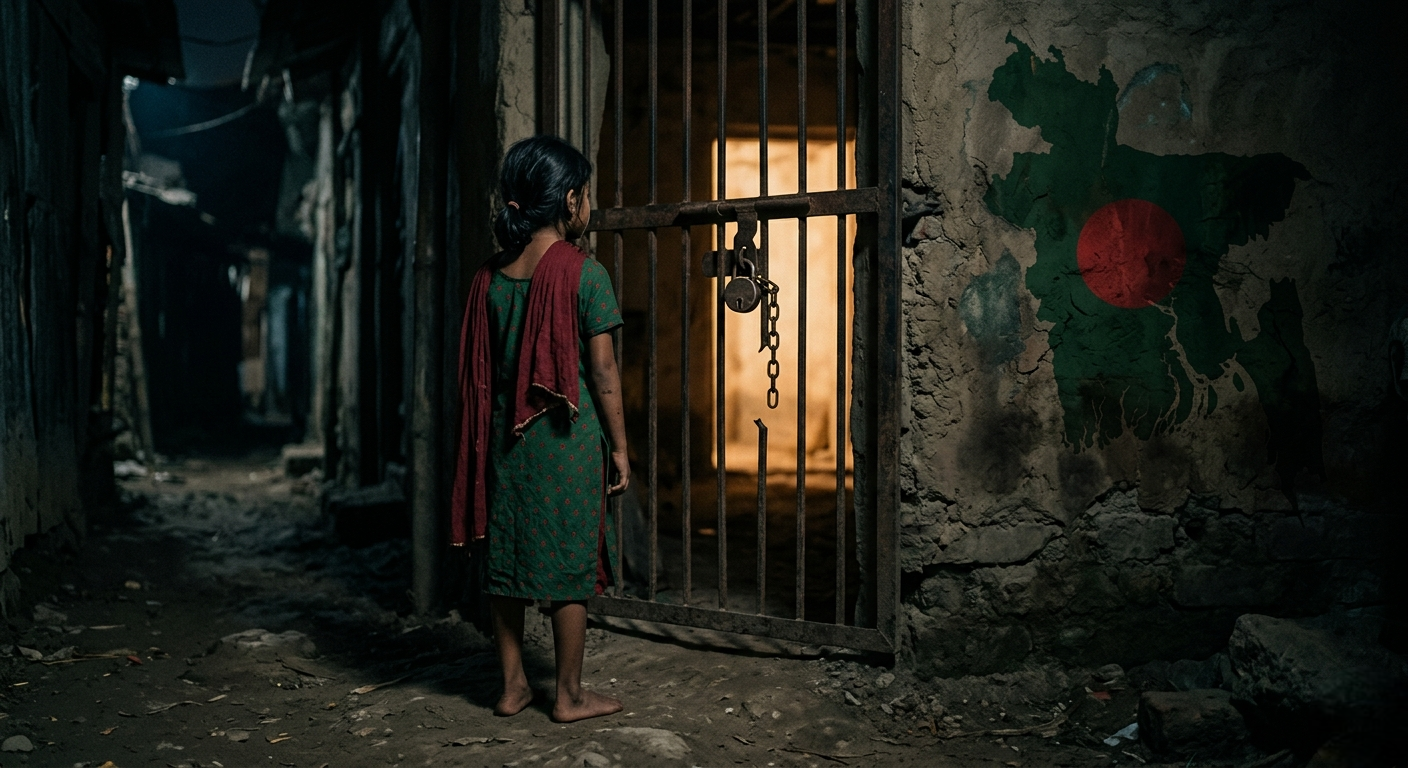
The most fundamental responsibility of a civilized society is to ensure the protection of its children. But recent statistics and the flow of events in Bangladesh are painting a picture of deep failure in fulfilling that responsibility. The information that has emerged since the beginning of 2026 regarding the rape and murder of girl children is not merely a law and order problem — it is the manifestation of a profound human rights crisis. In this piece, I will attempt to shed analytical light on the nature, causes, and possible remedies of that crisis.
A National Crisis in the Language of Statistics
According to data from Ain o Salish Kendra (ASK), in just four and a half months from 1 January to 20 May 2026, 118 girl children have been victims of rape. Another 46 have been victims of attempted rape. 14 children have been killed after rape, and three have been killed after failed attempts at rape. Furthermore, two children who were victims of rape subsequently died by suicide — which is a heartbreaking acknowledgment of the long-term effects of trauma beyond the primary crime.
In just the first 20 days of May alone, 24 children have been raped and five have been killed. That means on average one child is being killed after rape every four days. Data from Police Headquarters shows that from January to April, 5,958 cases of violence against women and children were filed across the country. During the same period, 5,853 calls related to child sexual harassment were received at the Bangladesh Child Helpline.
These numbers are not mere statistics. Behind every number lies the story of a child’s life, a family’s devastation, and a society’s moral decline.
The Nature of the Incidents: Abuse at the Hands of Familiar People
Analysing five recent incidents, a disturbing pattern becomes clear — in every case, the child was abused by a neighbour, relative, or close acquaintance. This reality is consistent with international child protection research — where it has been found that a vast proportion of child sexual abuse occurs within familiar settings.
The incident in Sirajdikhan, Munshiganj is particularly relevant in this regard. Taking advantage of the mother and elder sister being at their workplace, a relative raped the 10-year-old child. The child was then strangled to death out of fear that she would lodge a complaint. The rape and throat-slitting murder of a child as young as 8 years old in Pallabi, Dhaka, followed by the dismemberment of the body, has deeply alarmed sociologists and psychoanalysts. Read more about this here.
There is a common thread between these two incidents: the perpetrator wanted to ensure that no witness remained alive. This is not merely an expression of brutality, but rather proves that within the criminal’s mind there was a latent fear of justice. The opportunity for an important deterrent lies precisely in making that fear a reality.
The Roots of the Crisis: Multidimensional Causes
While there may be a temptation to view these incidents as isolated crimes, experts agree that they are symptoms of a deeper social crisis. Professor Dr. Muhammad Umar Faruk of the Criminology Department at Mawlana Bhashani University of Science and Technology has identified several causes.
First, the widespread spread of drug addiction. The rate at which the availability and use of drugs is increasing in Bangladesh is paralleled by a similar increase in violent crime. A drug-addicted person’s capacity for moral judgement diminishes, which can push them towards extreme crimes.
Second, unregulated digital content. The easy availability of distorted and sexually violent content on the internet is a global problem, but in the absence of effective digital literacy and content regulation in Bangladesh, its harmful effects are even greater.
Third, the lack of moral education in families and educational institutions. If respect, boundaries, and regard for the rights of others are not cultivated from childhood, a moral vacuum is created in society.
Fourth, a culture of impunity. When a criminal sees that others are committing the same crime and getting away with it, their confidence to commit crimes grows. Psychiatry Professor Dr. Helal Uddin Ahmed of Faridpur Medical College has drawn particular attention to this tendency of “copycat crime” — a series of incidents can create among other criminals a disposition to commit the same offence.
The Gap Between Legal Framework and Reality
The legal framework for child protection in Bangladesh is reasonably well-organised. The Prevention of Women and Children Repression Act 2000 (amended 2003), the National Children Policy 2011, and Bangladesh’s ratification of the United Nations Convention on the Rights of the Child (UNCRC) — together these amount to a strong protection system on paper.
Yet according to the observation of former District Judge Ikteder Ahmed, the core crisis lies not in the existence of law, but in its application. He has identified three main problems: weak investigation, procedural complexities, and in some cases, corruption. If an investigation report contains flaws, even the most conscientious judge cannot ensure justice.
Added to this is the massive imbalance between the number of judges and the number of cases. This delay does not merely postpone justice, but mentally exhausts the victim’s family and sends the message to society that there are no consequences for crime.
From the perspective of international human rights law, this is in direct conflict with Article 19 of the UNCRC (protection of children from all forms of violence) and Articles 37 and 40 (the right to access justice).
Towards Structural Change: A Human Rights-Centred Approach
Given the depth of the problem, no single solution is sufficient. In the words of human rights activist Abu Ahmed Faizul Kabir, “If children are not safe, society will not be safe either.” Keeping this truth at the centre, several coordinated steps can be discussed.
Judicial Reform: Fast-track tribunals for cases of child abuse must be made more effective. Formation of specialist investigation teams and enhancement of forensic capabilities are urgently needed in this regard.
Social Awareness: Safety education programmes must be introduced at the school level to prevent child sexual abuse. It is the responsibility of the state to create an environment where children can safely lodge complaints.
Family Vigilance and Support: Since most abuse is occurring at the hands of familiar people, alongside raising awareness among families, it is necessary to build a social protection network for children who are left alone.
Digital Regulation: Government policy and technological intervention are needed to regulate online content harmful to children.
A Culture of Accountability: Without enhancing the competence of investigating officers and ensuring a corruption-free investigation system, justice will not be effective.
Conclusion
The growing crisis of rape and murder of girl children in Bangladesh is a warning — it is not merely criminal statistics, it is a call for a society’s self-examination. Without the coordinated effort of the state, families, civil society, and international partners, it is not possible to overcome this crisis.
From a human rights perspective, one thing is clear: every child, regardless of their gender or family position, has the right to live with dignity and safety. Ensuring this right is not merely a legal obligation — it is the moral duty of a civilised society.
Until we are able to place this truth at the centre of social and state policy, this crisis will only continue to deepen.
References
Ain o Salish Kendra (ASK). (2026, May 22). Statistics on violence against children (January–20 May 2026). https://www.askbd.org/ask/statistics-on-human-rights-violations/
The Business Standard. (2026, May 22). 118 children victims of rape since January. https://www.tbsnews.net/bangladesh/118-children-victims-rape-january-ain-o-salish-kendra-1445441
The Daily Star. (2026, May 16). Man held over rape, murder of 10-year-old girl in Munshiganj. https://www.thedailystar.net/news/crime-justice/news/man-held-over-rape-murder-10-year-old-girl-munshiganj-4177416
The Daily Star. (2026, May 19). 8-year-old girl found beheaded in Pallabi. https://www.thedailystar.net/news/crime-justice/news/8-year-old-girl-found-beheaded-4180006
United Nations. (1989). Convention on the Rights of the Child. https://www.ohchr.org/en/instruments-mechanisms/instruments/convention-rights-child
Faruk, M. O. (2026). Statement on causes of rising child sexual violence. Department of Criminology, Mawlana Bhashani Science and Technology University.
Ahmed, H. U. (2026). Statement on copycat crime. Faridpur Medical College, Department of Psychiatry.